Urgent help
Someone won’t wake up.
Call 911 now.
Say they are unresponsive and not waking up. You do not have to mention drugs. In most states Good Samaritan laws protect you for calling.
You don’t know the address
This is the thing that slows an ambulance down most, and at a party almost nobody knows it. Your phone does.
Your phone works this out on its own. It isn’t sent to us or to anyone else, and on a phone it works with no signal.
Asleep, or not?
People wait because they don’t want to overreact. These take about ten seconds each and you don’t have to move them.
- Can you wake them up?
Shout their name. Then grind your knuckles hard into the middle of their chest, on the breastbone. It hurts, and that's the point.
- Are they breathing normally?
Watch the chest for fifteen seconds. Normal is around 12 to 20 breaths a minute, so you should see three or more in that time.
- What colour are their lips and fingertips?
Look at the lips, the fingernails, and the skin around the eyes. On darker skin the lips, gums and nail beds show it first.
- What does their skin feel like?
Back of your hand on their forehead or neck.
Based on the overdose signs in SAMHSA’s first responder toolkit, the same source as the five steps on this page. It is not a diagnosis and the steps are what to do either way.
This is an overdose if
- Unconsciousness, or you can't wake them up
- Slow or shallow breathing, or trouble breathing
- Fingernails or lips turning blue or purple
What to do
- Check if they respond
Say their name loudly. Shake them, rub your knuckles hard on their breastbone.
If they don't wake up, go to step 2 now.
- Call 911
Getting someone with medical training there is the essential step.
Give the dispatcher your exact address. Say the person is unresponsive and not waking up. You do not have to mention drugs.
Then do what the dispatcher tells you.
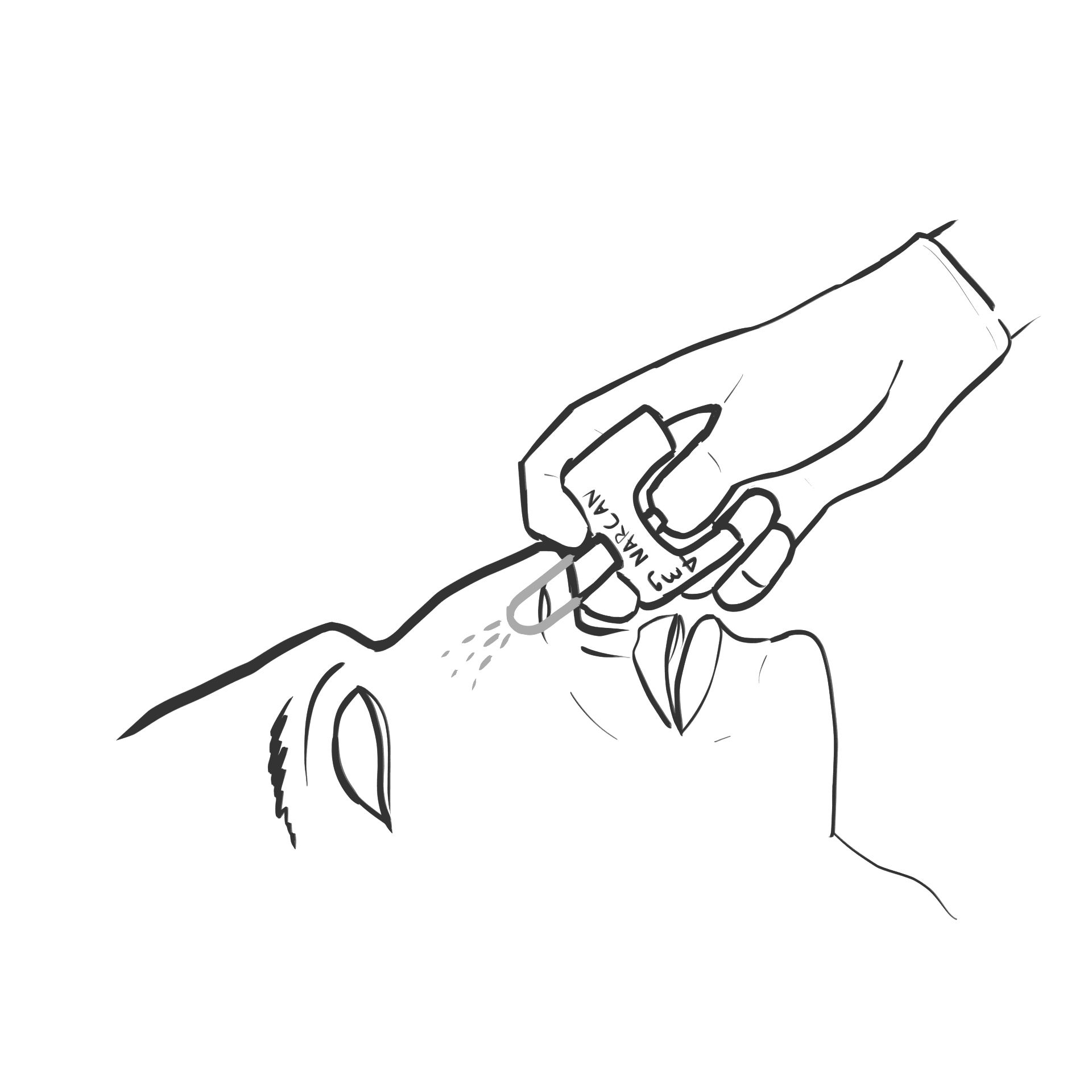
- Give naloxone if you have it
If there's no response within 2 to 3 minutes, give a second dose.
Strong opioids like fentanyl can take several doses. Keep going.
- Help them breathe
Clear the airway, tilt the head back, pinch the nose shut.
Give two slow breaths, then one breath every 5 seconds.
Chest compressions instead, if that's what you know how to do.
- Stay and watch them
Someone should be watching them for at least 4 hours in case it comes back.
They need to get to an emergency room even if they seem completely fine now.
If you have to leave them alone, roll them onto their side first.
Giving nasal naloxone
If you have to leave them
Adapted from SAMHSA's Five Essential Steps for First Responders, Opioid Overdose Prevention Toolkit. These steps are republished from a federal protocol and are not written by us. This page works with no internet connection once you’ve opened it once.