A little understanding
How to use a fentanyl test strip.
They’re free at several places in the county. Most people get the water ratio wrong or read the lines backwards, so both are spelled out here.
Where to get them free
The steps
- Put a small amount in a clean, dry container
At least 10mg — roughly the size of Abraham Lincoln's hair on a penny.
- Add water and mix
Half a teaspoon of water for most substances. A full teaspoon for meth or MDMA, because those cause false positives at higher concentrations. Mix it properly.
- Dip the wavy end for about 15 seconds
Hold the solid blue end. Don't let the water go past the blue line.
- Lay it flat for 2 to 5 minutes
Flat surface. Wait the full time.
Reading it — this is backwards from what you’d guess
The T line is the one that matters, and it works backwards from what you’d guess: if it’s missing, fentanyl was detected. Two lines is the result you want.
A real one, next to its instructions
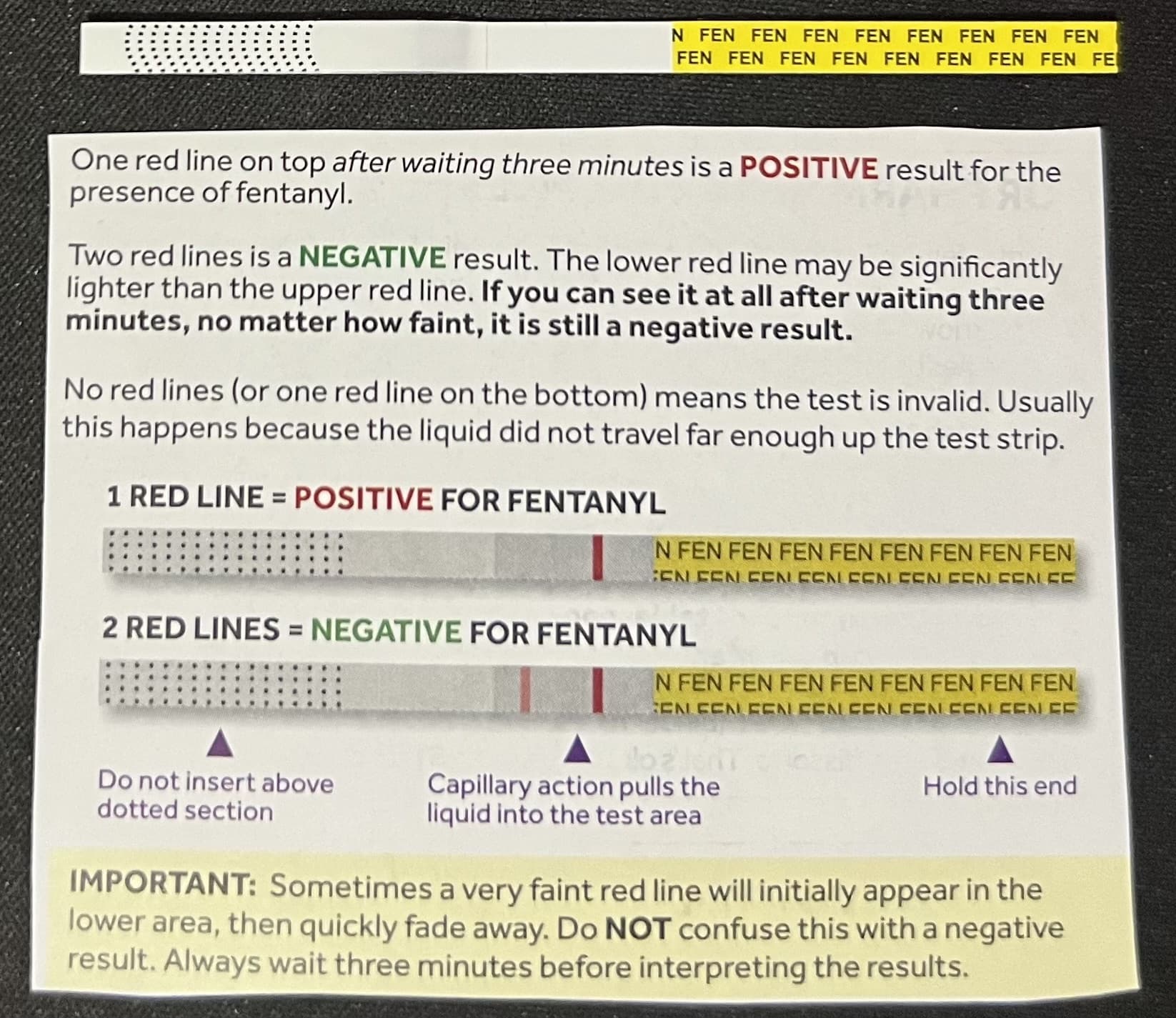
- The second line can be much fainter than the first. If you can see it at all after three minutes, however faint, it is still negative.
- A very faint line sometimes appears early and then fades. That is not a negative. Wait the full three minutes before deciding anything.
- One line on the bottom rather than the top means the test is invalid, usually because the liquid didn't travel far enough up the strip.
What a strip can’t tell you
- A strip tells you fentanyl is present or absent. It cannot tell you how much, how pure, or which fentanyl.
- Negatives are wrong about 3.7% of the time. A negative is not a guarantee.
- High concentrations of meth, MDMA, or diphenhydramine can cause a false positive.
- Fentanyl is not mixed evenly. Testing one part of something does not clear the rest of it.
A negative strip is not a green light. Have naloxone, and don’t be alone. Never Use Alone will stay on the phone and send help if you stop responding.
Instructions republished from New York State OASAS Fentanyl Test Strip Guidance.
One line. Now what?
A positive means fentanyl was in the bit you tested. It does not tell you how much, and it is never mixed in evenly, so the next bit can be far stronger than the bit you just checked.
- The safest thing is not to take it
Nothing else on this list is as effective as this one, and it is worth saying first even though it is the least likely to happen.
- If you're going to anyway, don't do it alone
Almost everyone who dies from an opioid overdose is by themselves. Never Use Alone stays on the line and sends help if you stop responding. Free, no name, no police.
- Have naloxone within reach, not at home
In the room, not in a drawer somewhere else. Someone who is not high should know where it is.
- Take much less than usual, and wait
Start with a fraction and give it time to come up before anything else. Tolerance means nothing against an unknown amount.
- Don't mix it with alcohol or benzos
Both slow breathing down on their own. Combined with an opioid, that is what actually kills people.
Two lines does not mean safe. The strip only checks the bit you dipped, it does not detect every analogue, and it says nothing about what else is in there. Everything above is still worth doing.